Product Description
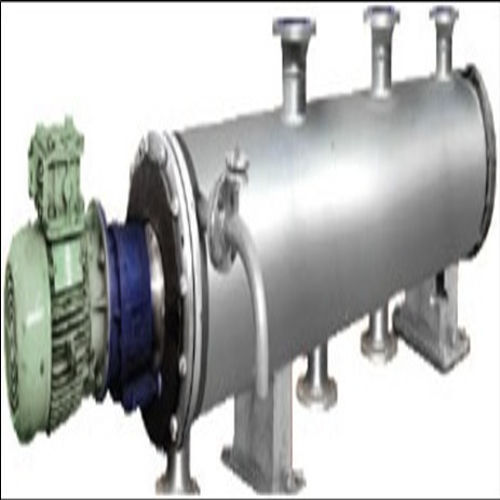
A plug flow cooling crystallizer is an equipment used for controlled crystallization processes. It facilitates efficient cooling of substances by maintaining a continuous and uniform flow pattern. The material being crystallized flows through the crystallizer while being subjected to controlled cooling conditions. Heat is extracted from the material using a coolant, such as chilled water or a refrigerant. The plug flow configuration ensures consistent crystal growth and size distribution, making it suitable for industrial-scale production. This crystallizer is widely used in pharmaceuticals, chemicals, food processing, and minerals industries to achieve precise crystal properties and high throughput rates.
Advanced Plug Flow CrystallizationHarnessing true plug-flow operation, the PFCC-3100 ensures consistent product quality by preventing back-mixing and facilitating uniform cooling along its length. This design is ideal for controlled particle size distribution-ranging from 50 to 500 microns-making it highly reliable for industrial crystallization, chemical production, and pharmaceutical manufacturing.
Intelligent Process Control and AutomationWith a fully PLC-controlled system and SCADA compatibility, this crystallizer allows precise monitoring and process adjustments. Ultrasonic level sensors, central lubrication, and automatic cleaning-in-place (CIP) simplify maintenance while ensuring hygienic operation, enhanced safety, and increased uptime.
Robust Construction and Efficient OperationManufactured from SS316/SS304 stainless steel and featuring a polished surface, the PFCC-3100 is designed to withstand rigorous industrial environments. Integrated with overload protection, emergency stop, and a centralized lubricating system, it assures safe operations. Multiple hinged covers provide ample maintenance accessibility, while effective insulation and jacketed water cooling optimize thermal efficiency.
FAQ's of Plug flow cooling crystallizer:
Q: How does the true plug-flow design of the crystallizer improve product quality?
A: The true plug-flow configuration ensures that each portion of feed moves uniformly through the crystallizer, minimizing back-mixing. This results in controlled crystal growth, consistent particle size, and high product purity-key for applications requiring reliable crystallization.
Q: What materials are used in the construction of the PFCC-3100, and why?
A: The crystallizer is fabricated from SS316/SS304 stainless steel, which offers superior corrosion resistance and mechanical strength. This ensures longevity, ease of cleaning, and compatibility with a wide variety of chemical substances processed in industrial environments.
Q: When and where is this plug flow cooling crystallizer most commonly used?
A: The PFCC-3100 is suitable for deployment in chemical processing, pharmaceuticals, and other industrial crystallization applications where precise temperature and particle control are critical. It is designed for floor-mounted installation in production facilities requiring high throughput and reliability.
Q: How is the crystallization process controlled and monitored?
A: Process control is achieved via a PLC-based system with SCADA compatibility, which allows real-time monitoring, automated operation, and integration with plant-wide control systems. The setup includes ultrasonic level sensors, automated lubrication, and CIP, optimizing operational efficiency.
Q: What are the main benefits of using an integrated plate-type heat exchanger in this unit?
A: The integrated plate-type heat exchanger provides rapid and uniform cooling, promoting efficient heat transfer and controlled crystallization. This allows for precise temperature management, resulting in superior crystal quality and reduced processing time.
Q: How is routine maintenance performed on the PFCC-3100?
A: Maintenance is simplified by multiple hinged covers for easy internal access, a centralized automatic lubricating system, and a clean-in-place (CIP) feature. These allow for efficient inspection, cleaning, and servicing, minimizing downtime and manual intervention.








 Send Inquiry
 Send Inquiry
 Send SMS
 Call Me Free